
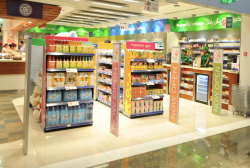
Modern convenience stores are being transformed by invisible digital layers that remove friction across payments, apps, automation and loyalty. As in-store sales overtake fuel profits, technology is enabling faster checkouts, app-led journeys, smarter loyalty and scalable operations—turning multi-mission stops into effortless experiences and redefining what “convenience” really means. (Image: Emarat)
GLO09 January 2026
The future of convenience retail isn’t announced by brighter lights or bigger food counters. It’s felt. It’s the difference between a stop that flows and one that frustrates. What separates the two is an invisible digital layer—software, data and automation working quietly in the background to compress time, reduce effort and turn multiple errands into a single, seamless visit.
This matters because convenience retail runs on repetition. According to NielsenIQ, the U.S. convenience channel attracts around 165 million visits every day, with the average shopper stopping by more than three times a week. At that frequency, even a few seconds saved—or a single pain point removed—adds up fast, both for customers and operators.
At the same time, the economics of the channel have shifted. While fuel still dominates sales value, in-store purchases now generate the majority of gross profit. The modern convenience site is no longer just a place to refuel vehicles; it’s a service hub where food, mobility, payments and digital services intersect. Technology is what keeps that complexity from slowing everything down.
Speed Is the New Currency
The most noticeable change for customers happens at the end of the journey: payment. Today’s shoppers arrive expecting transactions to be instant. Digital wallets, contactless cards and in-app payments have reset norms far beyond retail. McKinsey & Company reports steady growth in in-store digital wallet usage in the U.S., alongside widespread adoption of in-app payments.
For convenience retailers, speed at checkout isn’t just a nice-to-have—it’s capacity. Industry data shared by NACSshows that more than 80% of transaction value now flows through cards. Self-checkout and assisted self-service are no longer experiments; they are tools to manage peaks, offset labour shortages and keep lines moving during the busiest moments.
The Journey Starts Before the Forecourt
If payment defines the final seconds of a visit, mobile apps increasingly define the first decision. Modern convenience hubs are shifting from “being nearby” to “being chosen,” and that choice is often made on a screen before a driver ever turns in.
Apps now bundle services that used to be separate: site location, loyalty, mobile pay, digital coupons, food pre-ordering and EV charging status. Research from the American Customer Satisfaction Index shows that roughly a third of U.S. shoppers have already used a convenience store app to place an order—clear evidence that app-led journeys are becoming mainstream.
Some operators are pushing this further by turning apps into digital command centres. Repsol’s Waylet app, for example, integrates fuel payment, in-store checkout, EV charging, parking and partner rewards into a single interface. With more than 8.5 million users, it demonstrates how a well-designed app can anchor repeat behaviour and keep spending within one ecosystem.
Automation as a Growth Tool
As convenience sites add foodservice, parcel collection and mobility services, automation becomes less about novelty and more about survival. Self-checkout, kiosks, scan-and-go and workflow automation absorb volume while freeing staff to focus on food quality, availability and customer support.
NielsenIQ has noted that convenience retailers are increasingly investing in self-service technology, personalization and retail media—not as experiments, but as foundational capabilities for the next phase of growth.
Loyalty Becomes a Relationship, Not a Card
Once friction is removed, differentiation shifts to engagement. Loyalty programmes are evolving beyond points and discounts into always-on digital relationships that blend rewards, gamification, subscriptions and payment services. The goal is no longer just to reward a transaction, but to shape habits.
This evolution reflects a broader reality highlighted by Upside’s consumer spend research: shoppers are increasingly “uncommitted,” spreading their spend across more locations and comparing options more frequently. In that environment, loyalty must be earned through relevance, simplicity and value—not locked behind complexity.
Monetising Attention Without Breaking the Flow
Retail media is emerging as another layer in the modern hub, but its real potential lies beyond screens on the forecourt. When tied to apps, loyalty and payment data, retail media allows brands to reach customers at meaningful moments—without disrupting the experience.
As discussed at recent European retail forums, the opportunity isn’t selling shelf space; it’s monetising time and attention across the entire journey. Done poorly, it adds noise. Done well, it funds lower prices, better services and more personalised offers.
One Experience, Not Many Systems
What defines a “modern” convenience hub isn’t any single technology. It’s how well these systems—payments, apps, automation, loyalty and media—work together. Customers don’t think in categories; they judge a stop on one simple metric: did it feel effortless?
The most successful service hubs of the next decade won’t necessarily look radical from the outside. Their advantage will live beneath the surface, in digital layers that customers never see—but always feel.
Source: GLO
Disclaimer: Press release
© Press Release 2025
Send us your press releases to news@globalloyalty.org
Press releases originate from external third-party providers. This website does not have responsibility or control over its content, which is presented as is, without any alterations. Neither this website nor its affiliates guarantee the accuracy of the views or opinions expressed in the press release.
The press release is intended solely for informational purposes and does not offer tax, legal, or investment advice, nor does it express any opinion regarding the suitability, value, or profitability of specific securities, portfolios, or investment strategies. Neither this website nor its affiliates are liable for any errors or inaccuracies in the content, nor for any actions taken based on it. By using the information provided in this article, you agree to do so at your own risk.
To the maximum extent permitted by applicable law, this website, its parent company, subsidiaries, affiliates, shareholders, directors, officers, employees, agents, advertisers, content providers, and licensors shall not be liable to you for any direct, indirect, consequential, special, incidental, punitive, or exemplary damages, including but not limited to lost profits, savings, and revenues, whether in negligence, tort, contract, or any other theory of liability, even if the possibility of such damages was known or foreseeable.
The images used in press releases and articles provided by 3rd party sources belong to the respective source provider and are used for illustrative purposes in accordance with the original press releases and publications.
Disclaimer: Content
While we strive to maintain accurate and up-to-date content, Global Loyalty Organisation Ltd. makes no representations or warranties of any kind, express or implied, about the correctness accuracy, completeness, adequacy, or reliability of the information or the results derived from its use, not that the content will meet your requirements or expectations. The content is provided “as is” and “as available”. You agree that your use of the content is at your own risk. Global Loyalty Organisation Ltd. disclaims all warranties related to the content, including implied warranties of merchantability, fitness for a particular purpose, non-infringement, and title, and is not liable for a particular purpose, non-infringement, and title, and is not liable for any interruptions. Some jurisdictions do not allow the exclusion of certain warranties, so these jurisdictions may not apply to you. Global Loyalty Organisation Ltd. Reserves the right to modify, interrupt, or discontinue the content without notice and is not liable for doing so.
Global Loyalty Organisation Ltd. shall not be liable for any damages, including special, indirect, consequential, or incidental damages, or damages for lost profits, revenue, or use, arising out of or related to the content, whether in contract, negligence, tort, statute, equity, law, or otherwise, even if advised of such damages. Some jurisdictions do not allow limitations on liability for incidental or consequential damages, so this limitation may not apply to you. These disclaimers and limitations apply to Global Loyalty Organisation Ltd. and its parent, affiliates, related companies, contractors, sponsors, and their respective directors, officers, members, employees, agents, content providers, licensors, and advisors.
The content and its compilation, created by Global Loyalty Organisation Ltd, are the property of Global Loyalty Organisation Ltd. and cannot be reproduced without prior written permission.
