
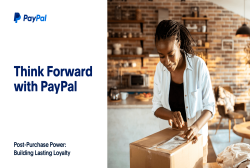
As e-commerce continues to evolve, the post-purchase phase has emerged as a pivotal stage in the customer journey. According to PayPal's 2025 "Think Forward with PayPal: Post-Purchase Power" report, forward-thinking brands are leveraging innovative strategies to enhance customer satisfaction, reduce returns, and foster long-term loyalty.

(Image Source)
GLOPost-Purchase Power: How Brands are Transforming Loyalty and Customer Experience:
As e-commerce continues to evolve, the post-purchase phase has emerged as a pivotal stage in the customer journey. According to PayPal’s 2025 “Think Forward with PayPal: Post-Purchase Power” report, forward-thinking brands are leveraging innovative strategies to enhance customer satisfaction, reduce returns, and foster long-term loyalty. With consumer expectations rapidly shifting, the post-purchase experience is no longer an afterthought—it’s now a key driver of repeat business and brand advocacy.
Key Trends in the Post-Purchase Landscape:
1. Mindful Marketing: Cutting Through the Noise
In a crowded digital landscape, consumers are bombarded with excessive marketing communication, often leading to frustration. According to the report:
- 73% of consumers globally say that a brand’s communication methods significantly impact their decision to repurchase.
- However, 75% of consumers unsubscribed from brand emails due to receiving too many messages.
Brands like GameStop are addressing this challenge with AI-driven tools to deliver personalized, relevant content during the post-purchase phase. For example, 29% of customers click back to GameStop’s site after receiving order updates, leading to additional sales.

(Image Source)
Image: PayPal
2. Conscious Consumption: Meeting Sustainability Demands
Consumers increasingly value durability and sustainability in their purchases. The report reveals:
- 67% of global consumers prefer to repair items rather than replace them.
- The resale market is projected to grow to $51 billion globally by 2026, reflecting a shift toward circular consumption.
Philips’ Refurb Editions program capitalizes on this trend by selling refurbished products under the tagline “Better than New,” generating 18% of its revenue in 2022, with a target of 25% by 2025.

(Image Source)
Image: PayPal
3. Reducing Returns: Enhancing Convenience
High return rates remain a challenge for e-commerce brands, with rates as high as 50% in some categories. However, flexible policies can drive customer loyalty:
- 84% of consumers review a retailer’s return policy before making a purchase.
- 53% have canceled a purchase due to an unsatisfactory return policy.
Amazon’s AI Fit Insights tool, which analyzes returns data to improve size and fit recommendations, has helped reduce return rates while enhancing customer satisfaction. Similarly, French startup Elyn’s “try before you buy” options have led to a 30% reduction in refund rates.

(Image Source)
Image: PayPal
4. Changing Channels: Building Community
Traditional social media platforms are seeing declining engagement, pushing brands to explore alternative channels and deeper community connections:
- Platforms like Substack have seen a 42% growth in usage as consumers seek more intimate and meaningful interactions.
- 34% of executives are investing in personalized, community-driven communications to strengthen loyalty.
Adidas’ AdiClub and The North Face’s XPLR PASS exemplify this trend. AdiClub allows customers to earn rewards through purchases, reviews, and fitness activities, contributing to 41% of Adidas’ direct-to-consumer sales. The North Face takes community building offline with exclusive Basecamp events in iconic outdoor locations, fostering deeper connections among brand enthusiasts.

(Image Source)
Image: PayPal
The Business Case for Post-Purchase Excellence:
1. Driving Repeat Purchases: The report highlights that 83% of customers are influenced by free shipping when deciding to make repeat purchases. Similarly, 81% prioritize free returns when choosing where to shop.
2. Enhancing Brand Loyalty: As 38% of European consumers report becoming less loyal to brands over the past year, businesses are increasingly investing in retention strategies. According to the report, 68% of executives plan to increase investments in loyalty initiatives, recognizing the critical role of post-purchase engagement.
3. Optimizing Customer Experience. Stress-free post-purchase experiences not only reduce buyer’s remorse but also improve brand perception:
- Shoppers experiencing low stress during their purchase journey are 25% more likely to repurchase and recommend the brand.
- Innovations like real-time tracking and flexible delivery options cater to customer desires for convenience and control.
Lessons for Brands: Seizing Post-Purchase Opportunities
To succeed in the evolving e-commerce landscape, brands must:
- Invest in Personalization: Tailor post-purchase communications to individual preferences, ensuring relevance and engagement.
- Promote Sustainability: Develop repair and resale programs to align with consumer values and build trust.
- Simplify Returns: Offer flexible and transparent return policies to reduce friction and enhance satisfaction.
- Build Community: Foster deeper connections by creating exclusive online and offline experiences that go beyond transactions.
The post-purchase experience is no longer just a conclusion to the customer journey—it’s an opportunity to build lasting relationships, enhance satisfaction, and differentiate in a competitive market. By embracing the strategies outlined in PayPal’s report, brands can turn post-purchase interactions into a powerful tool for driving loyalty and growth.
With innovative examples from leaders like Philips, GameStop, Adidas, and Amazon, the path forward is clear: prioritize quality over quantity, sustainability over disposability, and connection over mere communication. In doing so, businesses can not only meet evolving consumer expectations but also secure a competitive edge in the future of commerce.
Read in full
Source: PayPal
Disclaimer: Press release
© Press Release 2025
Send us your press releases to news@globalloyalty.org
Press releases originate from external third-party providers. This website does not have responsibility or control over its content, which is presented as is, without any alterations. Neither this website nor its affiliates guarantee the accuracy of the views or opinions expressed in the press release.
The press release is intended solely for informational purposes and does not offer tax, legal, or investment advice, nor does it express any opinion regarding the suitability, value, or profitability of specific securities, portfolios, or investment strategies. Neither this website nor its affiliates are liable for any errors or inaccuracies in the content, nor for any actions taken based on it. By using the information provided in this article, you agree to do so at your own risk.
To the maximum extent permitted by applicable law, this website, its parent company, subsidiaries, affiliates, shareholders, directors, officers, employees, agents, advertisers, content providers, and licensors shall not be liable to you for any direct, indirect, consequential, special, incidental, punitive, or exemplary damages, including but not limited to lost profits, savings, and revenues, whether in negligence, tort, contract, or any other theory of liability, even if the possibility of such damages was known or foreseeable.
The images used in press releases and articles provided by 3rd party sources belong to the respective source provider and are used for illustrative purposes in accordance with the original press releases and publications.
Disclaimer: Content
While we strive to maintain accurate and up-to-date content, Global Loyalty Organisation Ltd. makes no representations or warranties of any kind, express or implied, about the correctness accuracy, completeness, adequacy, or reliability of the information or the results derived from its use, not that the content will meet your requirements or expectations. The content is provided “as is” and “as available”. You agree that your use of the content is at your own risk. Global Loyalty Organisation Ltd. disclaims all warranties related to the content, including implied warranties of merchantability, fitness for a particular purpose, non-infringement, and title, and is not liable for a particular purpose, non-infringement, and title, and is not liable for any interruptions. Some jurisdictions do not allow the exclusion of certain warranties, so these jurisdictions may not apply to you. Global Loyalty Organisation Ltd. Reserves the right to modify, interrupt, or discontinue the content without notice and is not liable for doing so.
Global Loyalty Organisation Ltd. shall not be liable for any damages, including special, indirect, consequential, or incidental damages, or damages for lost profits, revenue, or use, arising out of or related to the content, whether in contract, negligence, tort, statute, equity, law, or otherwise, even if advised of such damages. Some jurisdictions do not allow limitations on liability for incidental or consequential damages, so this limitation may not apply to you. These disclaimers and limitations apply to Global Loyalty Organisation Ltd. and its parent, affiliates, related companies, contractors, sponsors, and their respective directors, officers, members, employees, agents, content providers, licensors, and advisors.
The content and its compilation, created by Global Loyalty Organisation Ltd, are the property of Global Loyalty Organisation Ltd. and cannot be reproduced without prior written permission.
