
Willie Walsh Report on the Air Transport Industry / Mehmet Tevfik Nane, Chair of the IATA Board of Governors / Big Picture Panel Summary / CEO Insights Panel Summary

(Image Source)
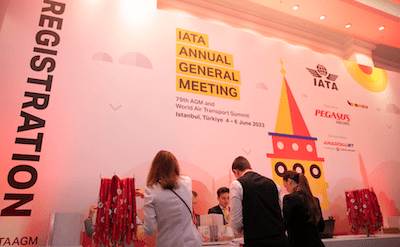
GLOThe IATA Annual General Meeting (AGM) and World Air Transport Summit is the world’s largest gathering of airline leaders. The 79th AGM and World Air Transport Summit, brought some 1500 aviation leaders, Strategic Partners and media to Istanbul, Türkiye, on 4-6 June 2023, hosted by Pegasus Airlines and co-hosted by AnadoluJet.
IATA’s membership now stands at over 305 airlines from all parts of the world and operating with many business models.
Willie Walsh Report on the Air Transport Industry (Full text here):
- Airlines are en route to a profitable, safe, efficient, and sustainable future … Latest data show passenger traffic at over 90% of 2019 levels … the airline industry has moved into profitability.
- Financial Performance: Margins are, however, wafer thin. With $803 billion of revenues, airlines will share $9.8 billion in net profit this year. Put another way, airlines will make, on average, $2.25 per passenger … Clearly that level of profitability is not sustainable. But considering we lost $76 per passenger in 2020, the velocity of the recovery is strong.
- Challenges remain:
- Inflation continues, cost pressure is acute, and in some areas, labor is in short supply.
- OEM suppliers have been far too slow in dealing with supply chain blockages that are both raising costs and limiting our ability to deploy aircraft. Airlines are beyond frustrated. A solution must be found.
- Oil companies did very well on our tab while the crack spread for jet fuel was at historic highs for most of 2022 until April this year.
- And there are grievous examples of some airports and ANSPs shifting the costs of their inefficiency to airlines… I can now confirm that Schiphol Airport has no shame. After a self-made operational disaster in 2022 the airport continues its three-year 37% charges hike—with 12% this year.
- Considering these many challenges, that airlines are turning a profit at the industry level is truly impressive.
- Efficiency and Implementation of Global Standards:
- IATA Financial Settlement Systems
- The transformation to modern airline retailing is taking shape. The aim is to make buying air travel as easy as ordering from any online retailer.
- Verifiable digital identity standards enabling all players in the supply chain to interact more efficiently and securely are being developed.
- And, with biometric identification, standards for contactless processes are improving the security and efficiency of the airport experience.
- Fragmentation is growing because governments are either not acting globally, not implementing completely, or simply inventing local solutions.
- Local Solutions: Passenger Rights
- Over a hundred jurisdictions have developed unique regulations intended to protect air travelers. And at least a dozen governments are looking to join the group or toughen what they already have.
- IATA survey (4,700 travelers across 11 markets) to understand their experiences.
-
-
- 96% were satisfied with their last trip
- 77% said air travel was good value for money, and
- 73% were confident they would be treated fairly by their airline in the event of operational disruptions
-
-
- Europe’s infamous EU 261 passenger rights regulation is a contorting contagion. It penalizes airlines for disruptions—misunderstanding that the huge costs of not operating to schedule are already a major incentive … the European Court of Justice continues to transform EU 261 from bad to absurd. Its latest judgement found that the death of a pilot, at an outstation, is not an extraordinary circumstance. Anyone with common sense would certainly wonder who the judges expect to fly the plane!… So we were amazed when the US announced that EU 261 will be the model for its punitive passenger rights regime. That closely followed Canada’s latest innovation on its 261-style regime where the airline is now guilty until proven innocent. … We must keep careful watch because governments from Australia to Latin America and the Middle East are all thinking about their own innovations in this area, which could be a nightmare for airlines and their passengers.
- The rotten tomato prize, however, goes to the “pay as you fly” initiative by the EU’s DG Justice. In a misguided initiative to protect travelers, airlines would only receive full payment when the journey is complete. The cashflow impact would be horrendous. And who’s interest will be served by the higher costs and higher fares that will result?
- It is a sad reality that we must remind governments that: 1) they should follow the passenger rights principles that they agreed through ICAO, especially on proportionality, and 2) that airlines serve passengers who are firmly in control of the ultimate passenger right—to choose the airline they spend their money with.
- The Importance of Fully Implementing Global Standards: Slots and Schiphol
- Problems also arise when global standards are not implemented as intended. There are two examples:
- The first is slots. The Worldwide Airport Slot Guidelines (WASG) underpin 43% of all journeys. And European data show they are effective with a 95% utilization rate and plenty of choice for consumers. Still, some regulators succumb to temptations to “toughen” the rules to be seen to be doing something…
- The second example is Schiphol. The Dutch government imposed a 12% capacity cut in a crude effort to manage noise. We won a court challenge because the government didn’t honor its decades-long commitments under the ICAO Balanced Approach on noise management…The Dutch government is appealing, and we continue to challenge for two reasons. An industry focused on safety cannot accept the politicization of technical discussions. And ignoring the rules-based order established by global standards is a slippery slope to confusion that we airlines can ill-afford and our customers will not tolerate. The message is simple. Global standards are key. When fully applied, they improve safety and drive consumer benefits, operational efficiencies and sustainably efforts.
- The Importance of Acting Globally: Sustainability
- And on sustainability, we have said from the beginning that it is a global challenge that needs a global solution.
- At the 41st ICAO Assembly in October 2022 governments agreed a long-term aspirational goal for aviation to achieve net zero emissions by 2050—aligning governments with our net zero by 2050 resolution at the 77th IATA AGM a year earlier. That’s important because governments are now accountable to deliver a global policy framework to achieve net zero by 2050.
- IATA has published a series of roadmaps to net zero by 2050. These roadmaps are the first detailed assessment of the key steps necessary to make net zero by 2050 an aviation success—covering technology, infrastructure, operations, finance and policy. They will, of course, evolve as we dig deeper to set interim milestones on the way to net zero. I must emphasize that the roadmaps are not just for airlines. Governments, suppliers, and financiers cannot be spectators to the challenge. We all have skin in the game. And each must deliver the products, policies or investments needed to decarbonize. Expert evaluation is essential. But too often even professional organizations contribute amateur assessments to this important debate. And that helps nobody. The latest that caught my eye, because it received widespread media coverage and is now often quoted, was a recent Royal Society report on resource requirements for net zero aviation fuels. To underpin their research, they used fuel burn performance data for flights between London and New York for a Boeing 737-300. Yes, you heard me right, a 737-300, an aircraft that went out of production in 1999, flying between London and New York. Now, I’ve flown the 737-300 so I know a bit about it and what I know for certain is you cannot get the minimum of 21 tonnes of fuel that they estimated you would require into the fuel tanks that can only take a maximum of 16 tonnes. So, if we know that that section of the report is rubbish what confidence can we have in the rest of the document? Decarbonizing aviation is a serious multi-trillion-dollar initiative. It must be informed by expert research that can stand up to scrutiny.
- And that leads me to a second important development since LTAG. IATA published a global standard methodology to track progress toward net zero. The transparency that accurate tracking will enable is critical to holding ourselves and our stakeholders accountable—accountable for what is achieved and what is not in the quest for a truly credible net zero by 2050 target.
- The ICAO Assembly increased CORSIA’s financial burden by adjusting the baseline to 85% of 2019 emissions. We accepted this as part of a political compromise to achieve LTAG and with the assurance that CORSIA would be the only economic measure applied to international aviation… the argument that international aviation is not taxed does not hold water. We analyzed data from almost 7 billion tickets for international flights going back to 2018 which showed that airlines have paid over $380 billion in taxes and charges which added over 33% to the price of a ticket. And if we include domestic flights, that figure of $380 billion rises to half a trillion US dollars. It’s important that policy makers are moved by facts not fictions and it’s heartening that 75% of travelers see green taxes for what they are—nothing more than government greenwashing!
- SAF
- our biggest focus is on SAF which will be the biggest contributor to net zero success.
- Today’s SAF production is less than 0.1% of what we need for net zero. But the trend is positive. In 2022, SAF production tripled to 300 million liters. And while critics of our industry dismiss that figure as irrelevant, it’s important to remember that airlines used every single drop costing almost $350 million. With the right supportive policies, reaching 30 billion liters by 2030 is challenging but achievable. That would be about 6% of the 450 billion liters annual production capacity we need in 2050. We think it will be the tipping point because achieving it will establish the trajectory needed to scale up for 2050.
- The willingness of airlines to use SAF is definitely not the issue… every drop of SAF ever produced has been purchased and used. The problem is insufficient production capacity to meet demand …politicians have not made good on their COP 26 promise to stop financing fossil fuels … The US approach to SAF is the most advanced with a system of tax credits to drive up production levels. This will be more effective than purchase mandates being considered as far and wide as Singapore, India and Europe. When there is not enough supply, a purchase mandate will drive prices up, stall innovation and limit competition long before supply increases.
- there is an early policy decision that is needed, it is to establish global standards for a SAF book and claim system that can fairly allocate SAF credits with no double counting…Just as location makes no difference on the impact of CO2 emissions, it has no impact on where SAF is uplifted and used either. A global approach to book and claim for SAF credits will help facilitate economies of scale in SAF production. And it will avoid the long-distance shipping (or even importation) of SAF, which would only degrade its climate credentials.
- Looking Ahead
- The sustainability challenge is, bar none, the biggest that we will face as leaders of the aviation industry. This will be difficult and take time.
- IATA research tells us that people appreciate what we do:
- 87% believe that flying is critical, and we must find a way to fly sustainably without restricting travel
- 88% feel that air travel has a positive impact on society
- 82% recognize aviation as a key contributor to the UN’s Sustainable Development Goals, and
- 91% see air connectivity as a modern necessity and
- 81% of travelers appreciate the freedom to fly more today than they did pre-pandemic
Mehmet Tevfik Nane, Chairperson of the Board of Directors, Pegasus Airlines, and Chair of the IATA Board of Governors (Full text here):
-
an agreement has been concluded between the United Nations Environment Programme, or UNEP, and IATA to cooperate in efforts to reduce the use of single use plastics onboard as well as to address other sustainability topics. This followed an excellent presentation by UNEP’s Economy Director at last year’s World Air Transport Summit in Doha.
-
discussion of Timatic AutoCheck, the IATA technology solution that is used by the aviation industry to ensure that over 700 million passengers every year have sufficient travel documents for their journey. Timatic is used by numerous airlines, ground handlers and travel agents globally, covering more than 50% of international air travel. In order to achieve this goal, a redevelopment of certain check-in processes will be required. As part of this program, IATA is collaborating with all major providers of Departure Control Systems or DCSs that will perform the integration work for airlines with whom they work.
-
discussion on the potential call for a global mandate on the use of sustainable aviation fuels by the upcoming ICAO Third Conference on Aviation and Alternative Fuels, the so-called CAAF/3.
Big Picture Panel Summary
- Marie Owens Thomsen, IATA’s SVP Sustainability and Chief Economist, noted that 2023’s anticipated GDP growth of 2.8% was “not great, but not bad,” a sentiment that ran through much of the discussion with positive and negative factors well balanced.
- Passenger numbers are expected to double from 4.4 billion in 2023 to 9.2 billion in 2040 with the biggest growth in Asia-Pacific.
- In the short term, airlines will make a net profit of $9.8 billion in 2023, equating to a 1.2% margin or $2.25 per passenger. And although cargo declined compared with previous few years, it is still well in advance of 2019 levels in terms of revenues and yield.
- There are risks, however, including a rise in jet fuel prices, blocked funds, global inflation, the war in Europe, and foreign exchange rates.
- Sustainability could be the main inhibitor of growth. Fatih Borel, Executive Director International Energy Agency, said net zero carbon emissions by 2050 is a “very ambitious target.” Aviation emissions are the hardest to abate compared with other transportation modes. Electrification of road transport is here and growing rapidly, for example.
CEO Insights Panel Summary
- frustration at aircraft delivery delays and the lack of spare parts… more fuel-efficient aircraft than today’s models will be vital to the industry meeting the 2050 net zero carbon emissions target.
- The panel accepted that achieving net zero by 2050 will be challenging, while agreeing that a degree of uncertainty is integral to the nature of any goal and technologies will advance rapidly. What is certain is the need for the entire aviation ecosystem, including governments, to be involved. Only through the support of partners and the right policy framework will net zero be achievable.
- In terms of technology, AI will perhaps have the greatest impact on aviation. In fact, Foran described it as “one of the most significant developments in my lifetime.” He also highlighted the potential of quantum computing.
- Makolo talked about the immediate issues of African growth and diversity. She said that increasing air traffic will depend on open borders more than open skies, with visas still difficult to obtain for intra-African travel. As for diversity, change is happening. Although there is still a long way to go, the issue has been recognized and there is the intention to improve, which are important first steps.
