



Hotel loyalty in 2025 looks very different from the familiar “stay more, earn more” model. Spend now matters as much as nights, points behave more like a flexible currency, and loyalty has expanded into everyday ecosystems powered by cards, partnerships and platforms. Add AI-driven trip planning and rising competition from super-apps, and the rules of loyalty are being rewritten. The question for 2026 is no longer if loyalty works — but how it must evolve to stay relevant.
 Global Hotel Alliance
As we close out 2025, it’s an excellent opportunity to reflect on how hotel and hospitality loyalty has evolved over the past year. The sector continues to mature rapidly, shaped by changing traveller behaviour, economic pressures and a growing shift from single-brand programs to broader loyalty ecosystems. To prepare for the opportunities and challenges of 2026, it’s worth reflecting on the key developments and trends that defined hotel loyalty in 2025.
 Courtesy of Global Hotel Alliance
Trend 1: From “frequent stayer” to “frequent spender”
For years, hotel status was about nights stayed. Thirty, fifty or seventy-five nights a year, and you were in. In 2025, that logic is fading. Across major hotel groups, spend is becoming as important as stays.
- Big programmes are increasingly linking rewards and elite benefits to room rate, premium brands and ancillary spend, not just nights.
- Luxury and lifestyle brands disproportionately accelerate elite qualification and points earning.
- Co-branded credit cards also play a growing role, offering spend-based elite night credits and shortcut paths to status.
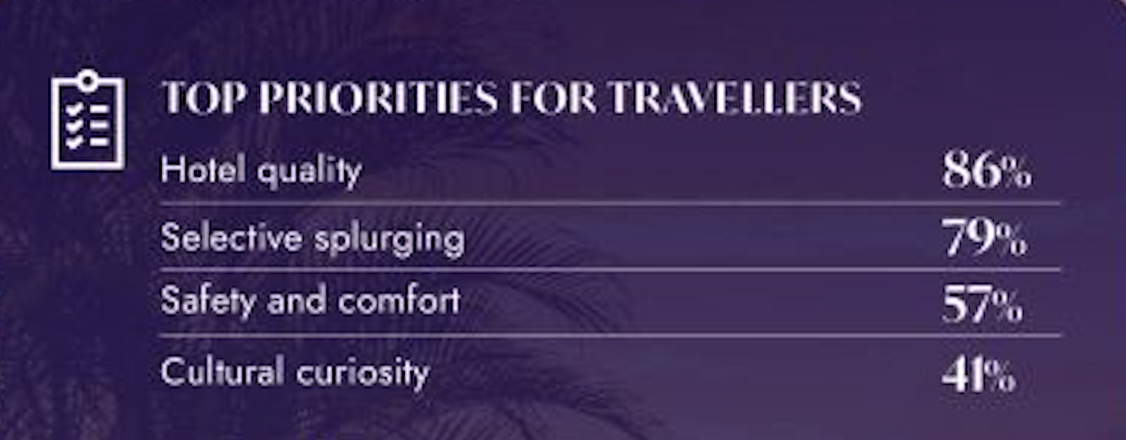
This shift is reflected in traveller intent. GHA DISCOVERY’s 2026 traveller insights research shows 79% of travellers plan to spend selectively on meaningful upgrades, prioritising comfort, location and experience over indiscriminate luxury spending. Rather than chasing status for its own sake, travellers are increasingly directing spend toward things that clearly improve the stay.
The hotel-side logic is familiar: reward guests who generate the most revenue.
For travellers, this means:
- Fewer economical shortcuts to top-tier status
- Greater value in premium stays, paid upgrades, dining and spa spend
- More creative paths to elite status through specific behaviours (such as staying across brands) or through partner promotions
Courtesy of Global Hotel Alliance
Trend 2: Dynamic pricing and the soft erosion of “free nights”
Hotel points haven’t escaped inflation. Most major programs now use fully dynamic award pricing, even if they avoid saying so explicitly.
- A beachfront resort in peak season can cost 2-3x times the points it did pre-2020.
- “From” award rates still exist, but availability is increasingly limited. In plain terms: that five-night reward stay you planned might still be “free”, but it now empties your account instead of leaving a healthy balance.
- Your points still work, but their purchasing power is less predictable, and often weaker than members expect based on past experience.
Cash + Points options are also more common, subtly positioning points as a discount rather than a full reward.
Despite this, hotel quality remains non-negotiable. The recent GHA DISCOVERY research shows 86% of travellers refuse to compromise on hotel quality, reinforcing why points are increasingly used to offset high cash rates rather than saved indefinitely for aspirational redemptions.
Finally, the value of points, while continually being adjusted, remains opaque and is difficult to calculate, though there are reward options that focus on transparency (such as DISCOVERY Dollars, where D$1 = US$1).
Trend 3: Loyalty programs as hospitality’s financial backbone
Hotel loyalty programs are no longer just marketing or guest-retention tools; they are core business assets. In 2025 we saw:
- Co-branded credit cards drive a large share of points issuance and revenue.
- Banks buy points in bulk, turning loyalty into a stable, high-margin business.
- Points are earned everywhere: groceries, rideshare, dining, streaming subscriptions – not just on the core business.
This creates two implications:
- Hotels are financially incentivised to sell more points, even as redemption costs rise.
- Programs are optimised for ecosystem engagement, not just occupancy.
Hotel points now function like a private currency backed by banks, not just beds.
Trend 4: Subscriptions, paid status and brand-led experiments
This financialisaton of loyalty aligns with a broader evolution from transactional rewards to lifestyle engagement. Looking ahead to 2026, 73% of travellers say they would consider purchasing a travel subscription offering ongoing lifestyle benefits – a clear signal that loyalty is being evaluated as an always-on value proposition, not just a stay-based reward.
Hotels continue to experiment – with mixed results.
Subscription-style offerings have emerged, particularly among lifestyle and luxury brands, and the results are uneven, with strong engagement among frequent guests but limited appeal to casual travellers.
Travellers are clear about what matters. GHA DISCOVERY data shows 44% value upgrades, early check-in and late check-out most, more than discounts and points, followed by time-saving, exclusive access and recognition. The lesson is consistent: loyalty works best when benefits feel earned and genuinely useful.
The challenge is to balance access to those benefits with increasing accessibility to them. The fast-tracks through credit cards, paid upgrades, partnerships, or subscriptions is diluting the more traditionally earned elites and is leading to crowded lounges, fewer upgrades and benefit prioritisation to an increasing pool of customers.
Trend 5: Brands vs platforms — the real battleground
One of the biggest shifts in 2025 is where loyalty lives. Hotels now compete on two fronts:
- Choice of hotel – “Stay with us wherever you go”
- Brand loyalty: “Where we have hotels” – stay with us first
- Program loyalty: “Where our network has hotels” – stay in the family
- Booking channel after the hotel is chosen: “Book on our preferred channels”
- Platform loyalty
- “Book direct” is usually preferred by brands as the lowest cost of sale
- On the hotel or brand’s website or app
- Or through the larger ecosystem/loyalty website or app
- “Book direct” is usually preferred by brands as the lowest cost of sale
- Platform loyalty
Not only do hotels compete for a booking with Online Travel Agents (OTAs), who spend billions on marketing and search placement, then offer an endless range of hotels across destinations and segments on a simple user interface, but now banks, platforms and super-apps are an the ones to watch, as they increasingly bundle hotels, flights, experiences and insurance under one rewards umbrella.
For many travellers, loyalty to a booking platform is about whoever owns the most comprehensive supply and the best [and often easiest] experience.
This is why direct-booking perks, member-only rates and soft benefits like breakfast and late checkout have become so important, adding value to sway that final decision of where to book (while still resulting in the lowest net cost of sale).
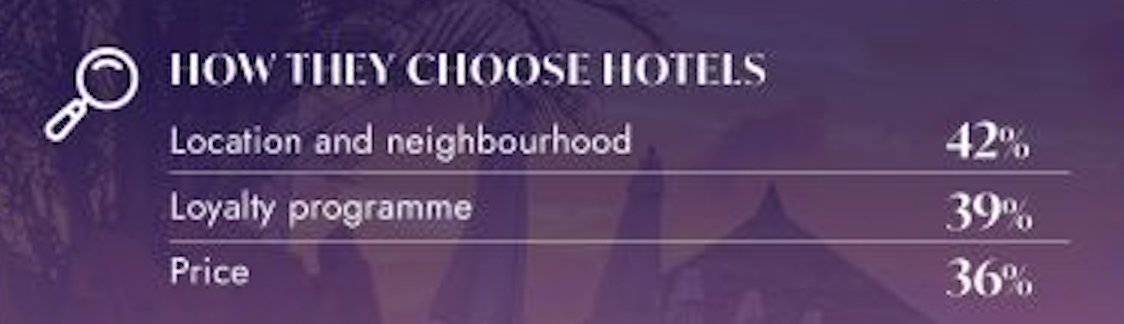
Alliance-led models highlight this shift. GHA DISCOVERY, operated by Global Hotel Alliance (GHA) has had a strong year, and its cooperation across international, regional and boutique brands demonstrates how relevance, flexibility and choice, and combined scale help the independent brands compete. Supporting this, the recent research shows that 42% of travellers prefer booking via the loyalty website or app, more than brand websites or apps at 30%, or OTAs at only 7%.
Trend 6: Trip planning and design via AI agents
2025 has seen the rise of AI-powered trip planning and autonomous agents, reshaping how trips are designed and how loyalty is discovered.
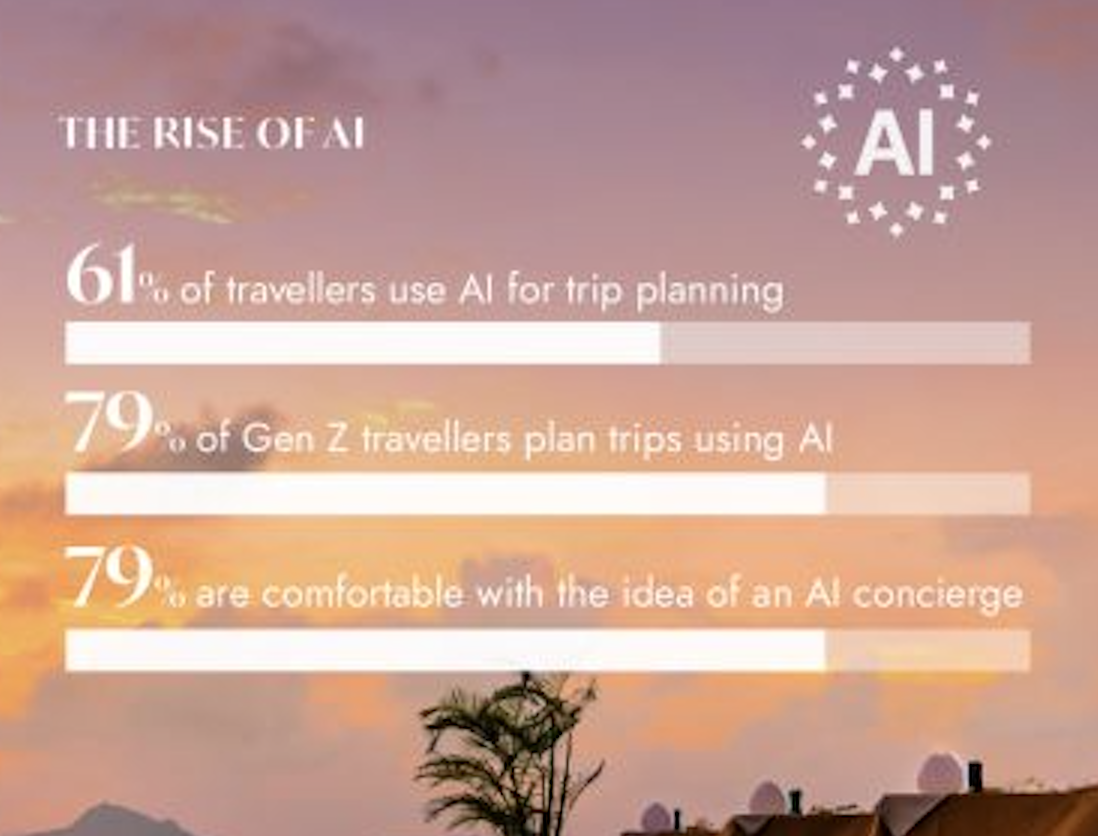
GHA DISCOVERY research sees that over 60% of travellers have already used AI tools (like ChatGPT or Gemini) for trip planning (rising to 79% for Gen Z), and almost 80% are comfortable with the idea of using an AI concierge going forward.
 Courtesy of Global Hotel Alliance
- Traditionally, brands have been able to largely control their messaging and influence where customers find them online and what they see, through earned or paid activities. But AI works differently, and businesses need to adjust the approach to be found and to ensure the content that is provided is accurate and effective. AI-driven planning tools often prioritise suggestions based on user preferences, reward value, price trends and ease of booking, rather than brand familiarity alone. Content that is optimised for machine-readable scanning and real-time availability rise in prominence.
- Agents can surface hotels across brands and ecosystems based on dynamic criteria – including price-to-points ratios, member benefits and personalised preferences, often beyond what travellers would actively search for themselves.
- For loyalty programmes, this trend is a double-edged sword: on one hand, AI can drive incremental demand by recommending stays and benefits travellers may not have considered; on the other, it can commoditise loyalty advantages if programmes fail to integrate seamlessly into the user experience that these agents provide.
Crucially, this also amplifies the role of ecosystems – alliances, cross-brand partnerships and shared rewards marketplaces – because AI agents perform best when they can access rich data across a wide range of options. This is why the industry’s shift toward broader collaborations and open loyalty networks, such as seen in the year’s growth of multi-brand alliances like GHA, plays directly into how loyalty will be chosen and used in an AI-mediated travel landscape.
The big picture
Hotel loyalty at the end of 2025 can be summarised simply:
- Programs are financially stronger, but more commercially driven
- Spend matters as much as stays
- Points are more flexible, but less predictable
- Elite status is easier to access, but less exclusive
- Loyalty extends beyond stays into everyday ecosystems
- Competition has moved from brands to platforms
- AI is reshaping loyalty discovery and choice
- Choice, relevance, transparency and ease matter most
The bottom line: Hotel loyalty still works in 2025 — but in a much bigger context.
GHA DISCOVERY’s research reinforces the direction for hotel loyalty: more personal, more selective and more ecosystem-driven. With 65% of travellers saying travel expresses who they are, loyalty programmes are increasingly expected to reflect identity, values and lifestyle – not just nights stayed or points earned.
Success now depends on understanding the rules, adapting quickly, and using loyalty strategically to deliver real value rather than chasing a version of loyalty that no longer exists.
Source: Kristi Gole, Executive Vice President of Strategy, Global Hotel Alliance.
Disclaimer: Press release
© Press Release 2025
Send us your press releases to news@globalloyalty.org
Press releases originate from external third-party providers. This website does not have responsibility or control over its content, which is presented as is, without any alterations. Neither this website nor its affiliates guarantee the accuracy of the views or opinions expressed in the press release.
The press release is intended solely for informational purposes and does not offer tax, legal, or investment advice, nor does it express any opinion regarding the suitability, value, or profitability of specific securities, portfolios, or investment strategies. Neither this website nor its affiliates are liable for any errors or inaccuracies in the content, nor for any actions taken based on it. By using the information provided in this article, you agree to do so at your own risk.
To the maximum extent permitted by applicable law, this website, its parent company, subsidiaries, affiliates, shareholders, directors, officers, employees, agents, advertisers, content providers, and licensors shall not be liable to you for any direct, indirect, consequential, special, incidental, punitive, or exemplary damages, including but not limited to lost profits, savings, and revenues, whether in negligence, tort, contract, or any other theory of liability, even if the possibility of such damages was known or foreseeable.
The images used in press releases and articles provided by 3rd party sources belong to the respective source provider and are used for illustrative purposes in accordance with the original press releases and publications.
Disclaimer: Content
While we strive to maintain accurate and up-to-date content, Global Loyalty Organisation Ltd. makes no representations or warranties of any kind, express or implied, about the correctness accuracy, completeness, adequacy, or reliability of the information or the results derived from its use, not that the content will meet your requirements or expectations. The content is provided “as is” and “as available”. You agree that your use of the content is at your own risk. Global Loyalty Organisation Ltd. disclaims all warranties related to the content, including implied warranties of merchantability, fitness for a particular purpose, non-infringement, and title, and is not liable for a particular purpose, non-infringement, and title, and is not liable for any interruptions. Some jurisdictions do not allow the exclusion of certain warranties, so these jurisdictions may not apply to you. Global Loyalty Organisation Ltd. Reserves the right to modify, interrupt, or discontinue the content without notice and is not liable for doing so.
Global Loyalty Organisation Ltd. shall not be liable for any damages, including special, indirect, consequential, or incidental damages, or damages for lost profits, revenue, or use, arising out of or related to the content, whether in contract, negligence, tort, statute, equity, law, or otherwise, even if advised of such damages. Some jurisdictions do not allow limitations on liability for incidental or consequential damages, so this limitation may not apply to you. These disclaimers and limitations apply to Global Loyalty Organisation Ltd. and its parent, affiliates, related companies, contractors, sponsors, and their respective directors, officers, members, employees, agents, content providers, licensors, and advisors.
The content and its compilation, created by Global Loyalty Organisation Ltd, are the property of Global Loyalty Organisation Ltd. and cannot be reproduced without prior written permission.
