

Since the outbreak of the conflict, outbound flight bookings from Middle Eastern countries have decreased by nine percentage points. The slowdown is evident in various regions, with the Americas experiencing a 10-point decrease, Asia Pacific, Europe (including Israel), and Africa each slowing by two points.

(Image Source)
GLOAccording to travel analytics from ForwardKeys, the recent conflict between Israel and Hamas has had a detrimental impact on flights to and from the Middle East, contributing to a global slowdown in the aviation industry. Since the outbreak of the conflict, outbound flight bookings from Middle Eastern countries have decreased by nine percentage points. The slowdown is evident in various regions, with the Americas experiencing a 10-point decrease, Asia Pacific, Europe (including Israel), and Africa each slowing by two points.

(Image Source)
Analyzing the destination perspective, the growth in flight bookings to all regions of the world has decelerated, except for Africa, which continues to recover toward 2019 levels. Flight bookings to the Americas have decreased by 6pp, Europe by 3pp, Asia Pacific by 1pp, and the Middle East by 26pp.
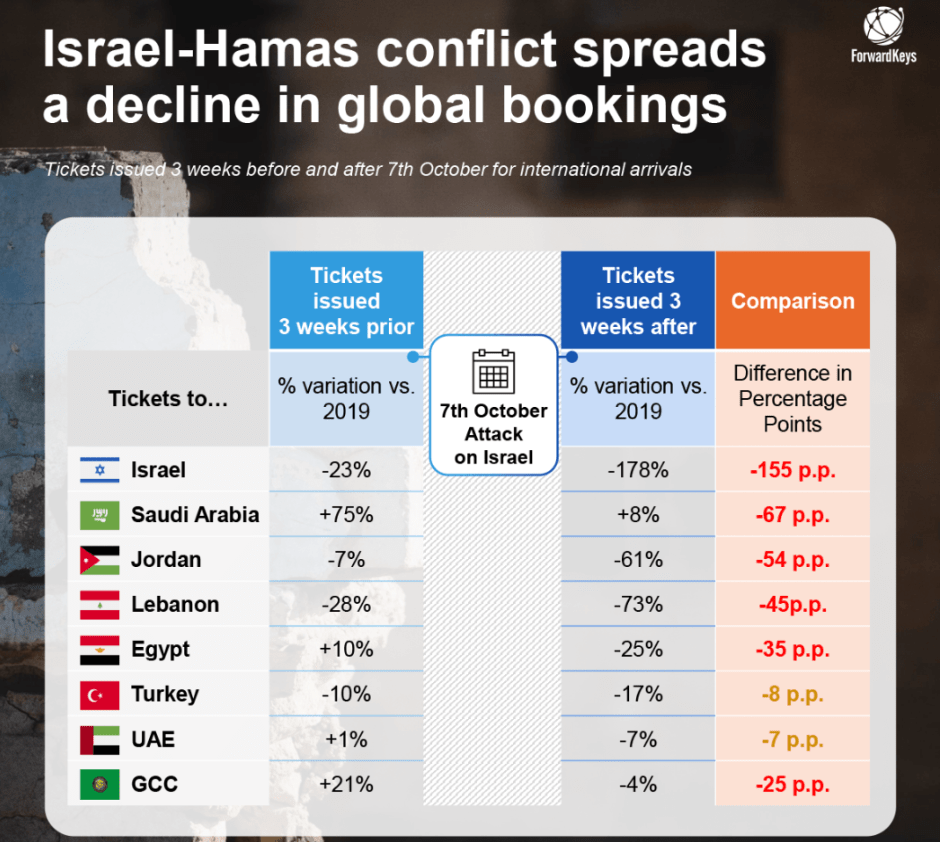
Within the conflict-affected region, Israel has been severely impacted, with numerous airlines canceling flights. Since October 7, flight bookings to Israel have plummeted by 155pp. Other affected nations include Saudi Arabia (down 67pp), Jordan (down 54pp), Lebanon (down 45pp), and Egypt (down 35pp). Flight bookings to Gulf Cooperation Council (GCC) nations have declined by 25pp.
Olivier Ponti, VP of Insights at ForwardKeys, commented on the situation, stating, “This war is a catastrophic, heartbreaking human tragedy that we are all seeing daily on our TV screens. That is bound to put people off traveling to the region, but it has also dented consumer confidence in traveling elsewhere too.”
As of October 6, global air travel in the last quarter of the year (Q4) was expected to reach 95% of its 2019 level. However, as of October 27, the outlook has fallen back by 7pp to 88%. The Middle East has experienced a more substantial decline in outlook, falling back by 16pp to 110%, from 126% before the conflict began.

(Image Source)
Source: ForwardKeys
