


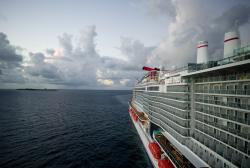
Carnival Corporation’s third-quarter 2025 earnings confirmed that the cruise giant has transitioned from post-pandemic recovery to a new phase of sustained profitability. The company’s performance was driven by higher yields, premium pricing, strong onboard spending, and strategic investments in private-destination assets and a revamped loyalty programme.
 Carnival Cruise Line
Carnival Corporation’s third-quarter 2025 earnings demonstrate that the world’s largest cruise operator is no longer in recovery mode — it’s in reinvention mode. The company beat expectations on revenue and profit, lifted its full-year outlook, and highlighted how new growth engines — including its expanding fleet, private-island investments, and forthcoming loyalty overhaul — are reshaping the economics of cruising.
Carnival’s story is increasingly about value creation over volume, transforming the traditional cruise business into a connected ecosystem spanning sea, shore, and digital engagement.
Financial Performance Highlights
For Q3 2025, Carnival posted revenue of approximately US $8.15 billion, up sharply year-on-year and ahead of analyst expectations. Adjusted earnings per share reached $1.43, roughly 8% above consensus forecasts.
The company raised its full-year guidance, projecting 5% yield growth in constant currency and adjusted EBITDA of US $6.9 billion. Customer deposits hit a record US $8.5 billion, reflecting robust demand visibility into 2026 sailings.
Debt ratios also continued to improve, with net-debt-to-EBITDA declining to 3.7× from 4.1× in the previous year. Carnival has refinanced high-cost borrowings, extended maturities, and improved its liquidity position, giving it more flexibility to invest in fleet modernisation and customer experience initiatives.
Strategic Levers Driving Monetisation
1. Premium Pricing and Yield Management
Carnival’s disciplined pricing strategy remains central to its profitability. Occupancy rates are near pre-pandemic peaks, and ticket prices are the highest in the company’s history. Instead of relying on discounting to fill ships, Carnival is leveraging analytics, segmentation, and dynamic pricing tools to manage demand and protect yields.
This “quality over quantity” approach has enabled Carnival to widen margins despite inflationary pressures and rising operating costs.
2. Onboard Revenue Growth
Onboard spending continues to drive incremental profit. Guests are spending more on experiences — including premium dining, beverage packages, spa treatments, Wi-Fi upgrades, and shore excursions — which generate higher margins than cabin fares.
Carnival has integrated its pre-cruise digital platforms with onboard sales systems, allowing passengers to pre-book experiences and packages before sailing. This not only boosts revenue per passenger but also improves onboard operations and reduces friction in the guest journey.
3. Private Island and Destination Assets
Carnival’s ownership and development of private destinations are changing its financial profile. Projects like Celebration Key in Grand Bahama, a roughly US $600 million investment, allow the company to capture spending that once went to external tour operators or port authorities.
Owning and controlling destination assets also provides brand differentiation — enabling Carnival to tailor experiences to specific demographics, extend onboard entertainment to land, and maintain pricing integrity across the entire cruise experience. These destinations also deliver valuable operational advantages: shorter docking times, lower port fees, and controlled guest flows.
4. Loyalty Programme Revamp: “Carnival Rewards”
Among its most transformative initiatives, Carnival is overhauling its loyalty ecosystem with the upcoming “Carnival Rewards” programme, set to launch in mid-2026. The initiative marks a fundamental shift in how the company thinks about customer value — moving from voyage-based recognition to behaviour-based engagement.
From Voyages to Value
Historically, cruise loyalty programmes have rewarded frequency — the number of cruises taken or nights spent at sea. Carnival Rewards redefines that logic by recognising total economic contribution, including onboard purchases, excursion bookings, and spending across Carnival’s sister brands such as Princess, Holland America Line, and Costa Cruises.
This shift aligns with broader trends in loyalty design across travel and hospitality: rewarding not just presence but participation.
Data-Driven Personalisation
Carnival is leveraging its upgraded data and analytics infrastructure to deliver real-time personalisation. Through enhanced CRM and machine-learning models, the company will identify guest preferences before, during, and after sailings. This will enable:
-
Personalised offers and cross-sell opportunities.
-
Dynamic upgrades and experience bundles.
-
Targeted rewards based on behaviour patterns (e.g., spa enthusiasts, family travellers, or foodies).
The company plans to integrate its loyalty data with its mobile app and onboard systems, ensuring guests can view points, status tiers, and reward options in real time — creating the same immediacy that airline and hotel programmes have achieved.
Seamless Integration Across Brands
Carnival Rewards will unify loyalty engagement across its entire multi-brand portfolio. Members will be able to earn and redeem benefits across multiple cruise lines under the Carnival umbrella, breaking down the silos that currently separate brand-specific reward systems.
This networked approach will give guests more flexibility in planning trips, expand recognition opportunities, and strengthen cross-brand retention — similar to how airline alliances allow reciprocal status and earning.
The Business Impact
For Carnival, the implications are significant:
-
Higher retention and lifetime value: Members who engage with loyalty programmes spend 2–3× more on average and exhibit much lower churn.
-
Data leverage: With a consolidated loyalty dataset, Carnival can better understand travel frequency, ancillary purchasing, and demographic trends.
-
Partnership potential: The company could eventually extend Carnival Rewards into co-branded credit cards, retail partnerships, and digital ecosystems.
The timing is strategic — launching as demand remains strong and the fleet expands gives Carnival a platform to convert first-time cruisers into repeat customers with structured incentives.
Why Loyalty Is the Next Profit Lever
The loyalty transformation mirrors the evolution seen in airlines and hotels over the past two decades. Once considered a marketing tool, loyalty has become a core profit driver and balance-sheet asset for travel companies.
For Carnival, this shift is about building emotional as well as transactional loyalty. The goal is to make guests feel recognised before they board, rewarded while they sail, and re-engaged after they return home — a continuous loop of interaction that enhances both experience and economics.
By tying loyalty to behaviour, data, and personalisation, Carnival is building a foundation for recurring revenue and lifetime engagement rather than one-off transactions.
Why the Strategy Matters
Carnival’s integrated approach — combining premium pricing, destination control, and data-driven loyalty — is reshaping its growth trajectory. Rather than compete on capacity, the company is creating a differentiated product ecosystem that maximises guest value at every stage of the journey.
Analysts note that this integrated model strengthens pricing power, provides insulation against external shocks, and aligns Carnival’s financial outcomes with customer satisfaction — a rare combination in the travel sector.
Risks and Considerations
Carnival’s progress is notable but not risk-free:
-
Its debt load remains significant, and higher interest rates could slow deleveraging.
-
Loyalty-system integration across brands and technologies poses execution challenges.
-
Investments in private islands are capital intensive, with returns dependent on sustained passenger volumes.
-
Consumer spending trends remain sensitive to macroeconomic volatility.
Despite these factors, the company’s disciplined cost control, growing yield, and strategic diversification place it in a stronger competitive position than at any point since before the pandemic.
Global Loyalty Organisation Take:
From a global loyalty management perspective, Carnival’s strategy signals a paradigm shift in how large travel companies are monetising loyalty ecosystems. Traditionally, cruise lines have lagged airlines and hotels in leveraging loyalty as a standalone economic engine. Carnival’s approach may change that.
1. Convergence of Loyalty and Payments:
Carnival Rewards has the potential to integrate payment instruments such as co-branded cards and digital wallets, blurring the line between commerce and recognition. This echoes moves by airlines (e.g., Delta and American) and hotel chains (Marriott Bonvoy, Hilton Honors) that have turned loyalty programmes into multi-billion-dollar financial ecosystems.
2. Behavioural Loyalty over Frequency Loyalty:
By shifting from voyage counting to value-based engagement, Carnival is aligning with the global trend toward behavioural loyalty — rewarding customers for what they spend, not just how often they travel. This model encourages continuous interaction across digital, retail, and experiential touchpoints.
3. Unified Cross-Brand Framework:
The consolidation of loyalty across multiple cruise brands reflects best practices from the global airline alliance model, allowing reciprocal benefits while maintaining brand individuality. It enhances network stickiness and supports tier progression for high-value guests.
4. Integration of Destination Assets:
By linking loyalty to its private-island experiences, Carnival can embed its rewards directly into controlled environments — a powerful way to drive repeat behaviour and maximise owned-channel monetisation.
5. Strategic Opportunity for Partnerships:
The new structure opens doors for collaborations with credit-card issuers, retail brands, and digital marketplaces. With the cruise industry’s high-spend demographics, this could become an attractive platform for co-branded loyalty ventures.
In short, Carnival is turning loyalty from a marketing metric into a profit lever, mirroring global best practices in travel and hospitality. Its 2026 rollout of Carnival Rewards could set a new benchmark not just for cruise lines, but for the wider experiential travel industry.
Carnival’s Q3 2025 performance highlights a company executing a multidimensional strategy: expanding fleet capacity, enhancing destinations, and embedding loyalty as a driver of sustainable profit.
The coming year will test how well these initiatives integrate, but the blueprint is clear — Carnival aims to own the guest relationship across the full travel lifecycle.
In essence: Carnival is no longer just selling cruises; it’s engineering a connected experience economy — one where every interaction, purchase, and memory strengthens the bond between guest and brand.
Source: Carnival Corporation
Disclaimer: Press release
© Press Release 2025
Send us your press releases to news@globalloyalty.org
Press releases originate from external third-party providers. This website does not have responsibility or control over its content, which is presented as is, without any alterations. Neither this website nor its affiliates guarantee the accuracy of the views or opinions expressed in the press release.
The press release is intended solely for informational purposes and does not offer tax, legal, or investment advice, nor does it express any opinion regarding the suitability, value, or profitability of specific securities, portfolios, or investment strategies. Neither this website nor its affiliates are liable for any errors or inaccuracies in the content, nor for any actions taken based on it. By using the information provided in this article, you agree to do so at your own risk.
To the maximum extent permitted by applicable law, this website, its parent company, subsidiaries, affiliates, shareholders, directors, officers, employees, agents, advertisers, content providers, and licensors shall not be liable to you for any direct, indirect, consequential, special, incidental, punitive, or exemplary damages, including but not limited to lost profits, savings, and revenues, whether in negligence, tort, contract, or any other theory of liability, even if the possibility of such damages was known or foreseeable.
The images used in press releases and articles provided by 3rd party sources belong to the respective source provider and are used for illustrative purposes in accordance with the original press releases and publications.
Disclaimer: Content
While we strive to maintain accurate and up-to-date content, Global Loyalty Organisation Ltd. makes no representations or warranties of any kind, express or implied, about the correctness accuracy, completeness, adequacy, or reliability of the information or the results derived from its use, not that the content will meet your requirements or expectations. The content is provided “as is” and “as available”. You agree that your use of the content is at your own risk. Global Loyalty Organisation Ltd. disclaims all warranties related to the content, including implied warranties of merchantability, fitness for a particular purpose, non-infringement, and title, and is not liable for a particular purpose, non-infringement, and title, and is not liable for any interruptions. Some jurisdictions do not allow the exclusion of certain warranties, so these jurisdictions may not apply to you. Global Loyalty Organisation Ltd. Reserves the right to modify, interrupt, or discontinue the content without notice and is not liable for doing so.
Global Loyalty Organisation Ltd. shall not be liable for any damages, including special, indirect, consequential, or incidental damages, or damages for lost profits, revenue, or use, arising out of or related to the content, whether in contract, negligence, tort, statute, equity, law, or otherwise, even if advised of such damages. Some jurisdictions do not allow limitations on liability for incidental or consequential damages, so this limitation may not apply to you. These disclaimers and limitations apply to Global Loyalty Organisation Ltd. and its parent, affiliates, related companies, contractors, sponsors, and their respective directors, officers, members, employees, agents, content providers, licensors, and advisors.
The content and its compilation, created by Global Loyalty Organisation Ltd, are the property of Global Loyalty Organisation Ltd. and cannot be reproduced without prior written permission.
