


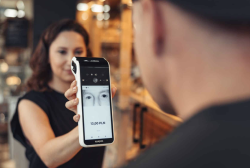
Traditional authentication methods like PINs or passwords are gradually giving way to biometric solutions, offering both heightened security and convenience. Biometric eWallets are emerging as a crucial component, securely storing payment and personal data with biometric verification, making physical cards or smartphones unnecessary for transactions.

(Image Source)
GLOThe authentication of digital payments is becoming more natural, quite literally. One of the latest advancements in payment evolution involves using biometric data, such as fingerprints, facial features, or iris patterns, to securely authorize transactions.
Recent article by PYMNTS.com cites Marc Hopkins, a vice president at E-Complish, although biometric authentication isn’t widespread in payments yet, it’s poised to become the norm, reshaping how consumers interact with payment systems and simplifying daily transactions like buying coffee.
Traditional authentication methods like PINs or passwords are gradually giving way to biometric solutions, offering both heightened security and convenience. Biometric eWallets are emerging as a crucial component, securely storing payment and personal data with biometric verification, making physical cards or smartphones unnecessary for transactions.
From a business standpoint, biometric payments offer multiple benefits including fraud reduction, improved customer experience, and operational efficiency. Despite concerns about data security and privacy, the unique advantages of biometric authentication make it a promising option for future payment systems.
In 2022 Mastercard introduced a program enabling merchants to implement biometric payment options such as facial recognition and fingerprint scanning. Instead of swiping cards, users can authenticate payments by presenting their face or palm. An executive mentioned that this technology could potentially contribute to building payment infrastructure for the “metaverse” in the future.
Education and integration are essential for widespread adoption of biometric payments. Building consumer trust and seamlessly integrating biometric options into existing infrastructure are key for scalability across various industries and applications, potentially extending beyond traditional transactions to areas like peer-to-peer communication and identity verification.
Source: GLO
