
Ad-Panel
Join GLO today for largest global network of loyalty & CX professionals and latest loyalty research & analysis.
Home » Articles » Amperity Report: The Retail Holiday Guide to AI & Customer Data

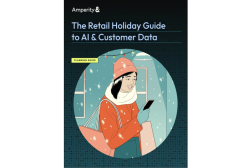
Amperity Report: The Retail Holiday Guide to AI & Customer Data

by GLO
0 comments

Black Friday and Cyber Monday have become critical data moments, not just sales peaks. As consumers remain cautious, retailers are turning to AI, identity resolution, and real-time customer profiles to personalise offers, optimise inventory, and predict future value. Brands that treat the holiday period as the starting point for year-round customer intelligence—and loyalty-building—gain a lasting competitive advantage beyond discounts.

GLOGLO

14 December 2025.

Black Friday and Cyber Monday are no longer just peak sales moments—they are critical data events. As retailers face cautious consumer spending and ongoing economic pressure, AI and unified customer data have become essential tools for navigating the holiday season and driving long-term growth.

Retailers that invest in identity resolution, real-time customer profiles, and AI-driven insights are better positioned to personalize promotions, manage inventory, and convert one-time holiday shoppers into loyal customers. The central message is clear: Black Friday should be treated not as an endpoint, but as the starting point for year-round customer intelligence and competitive advantage.

Key Takeaways

  • Black Friday is a customer data event, not just a sales event

  • Unified customer data is essential for personalization, forecasting, and AI performance

  • Real-time customer profiles enable faster, more precise decision-making

  • AI investment is now a competitive necessity, not an experiment

  • The biggest ROI comes after the holidays by converting one-time buyers into loyal customers

  • Strong 2026 performance starts with the data foundation built during this holiday season

Turning Holiday Peaks into Year-Round Advantage with AI and Customer Data

Black Friday and Cyber Monday shape the retail calendar more than any other events. Beyond their immediate revenue impact, they place enormous pressure on retail operations, technology systems, and customer engagement strategies. In 2025, these events arrive at a turning point: AI adoption in retail is accelerating, while consumers remain cautious due to inflation and broader economic uncertainty.

Nearly half of retailers now use AI on a daily or near-daily basis, and almost all plan to maintain or increase their AI investments. This holiday season represents one of the first opportunities for retailers to apply AI at scale—transforming how they listen to customers, learn from behavior, and act on insights across channels.

Image: Amperity

Listen: Build Unified Customer Profiles Before the Rush

Strong holiday performance starts with understanding past performance. Retailers must look beyond topline metrics like total revenue or conversion rates and examine how different customer segments behaved. Which products resonated? Which channels drove the highest-value traffic? Which promotions encouraged repeat purchases after the holidays?

Unified customer profiles are the foundation for answering these questions. Identity resolution—connecting customer data across devices, channels, and touchpoints—enables retailers to develop a complete view of each shopper. Without this capability, customer data remains fragmented, limiting the effectiveness of personalization, segmentation, and forecasting. A strong data foundation allows retailers to understand price sensitivity at the segment level and design promotions that balance perceived value with profitability.

Learn: Turn Holiday Insights into Q4 and Q1 Strategy

Black Friday should be treated as a launchpad, not a finish line. The insights gained during the holiday spike should immediately inform inventory and audience strategies for the remainder of Q4 and into the new year.

Retailers need to identify which products sold fastest, where inventory shortages occurred, and which items require targeted promotion. At the same time, customer data can be used to determine which audiences should be re-engaged during December and which newly acquired customers are worth investing in during Q1.

AI models built on clean, unified data make it possible to predict which customers are most likely to return, which respond best to higher-value incentives, and which benefit more from loyalty-driven messaging. Real-time customer profiles ensure these predictions are always based on the most recent behavioral signals, allowing retailers to move with speed and precision.

Act: Deepen Relationships Beyond the Holidays

The real work begins after the holiday season ends. Retailers must focus on turning one-time holiday buyers into long-term customers by separating new customers from existing ones and identifying signals of future purchase intent.

Customers who continue to engage with owned channels after Black Friday—through repeat site visits, email interactions, or app usage—are more likely to become regular buyers. Others may remain seasonal shoppers. Each group requires a different re-engagement strategy.

Seasonal buyers may respond best to timely, event-based messaging tied to post-holiday promotions, while high-potential customers benefit from personalized content that reflects their preferences, price sensitivity, and browsing behavior. Over time, real-time signals can power replenishment reminders, loyalty rewards, early access offers, and personalized product recommendations that strengthen long-term relationships.

Looking Ahead: Preparing for 2026

Black Friday and Cyber Monday provide the ultimate stress test for a retailer’s data and AI infrastructure. Post-holiday analysis should focus on whether AI-driven experiments delivered measurable improvements, whether customer segments were accurate and actionable, and whether identity resolution systems performed reliably under peak demand.

Retail success in 2026 will be determined by the data foundation built today. Retailers that invest in unified, AI-ready customer data will be better equipped to adapt quickly, personalize effectively, and turn short-term holiday spikes into sustainable, year-round growth.

Global Loyalty Organisation Take:

From a global loyalty perspective, the message is clear: loyalty is no longer built on points, perks, or promotions alone—it is built on data intelligence and relevance at scale.

Holiday shopping periods expose both the strengths and weaknesses of loyalty strategies. Brands that rely solely on transactional incentives risk acquiring customers who disappear once discounts end. In contrast, organisations that unify customer data and apply AI-driven insights are better positioned to recognise intent, personalise engagement, and build emotional loyalty beyond price.

What stands out is the shift from campaign-led loyalty to signal-led loyalty. Real-time behavioural signals—repeat visits, browsing depth, channel engagement, and post-purchase activity—are now stronger predictors of future value than historical spend alone. Loyalty organisations should view peak trading moments as diagnostic tools, revealing which customers are primed for long-term relationships and which require lighter, seasonal engagement.

The long-term opportunity lies in integrating holiday data into loyalty ecosystems year-round. By feeding unified customer profiles into loyalty programmes, brands can move from static tiers and blanket rewards to adaptive loyalty experiences that evolve with customer behaviour. This approach not only improves retention and lifetime value but also reduces reliance on margin-eroding discounts.

In short, loyalty leaders who treat peak periods as intelligence accelerators—not just revenue events—will be best positioned to drive sustainable growth in an increasingly competitive and cost-conscious global retail environment.

Source: Amperity.

Disclaimer: Press release
© Press Release 2025
Send us your press releases to news@globalloyalty.org
Press releases originate from external third-party providers. This website does not have responsibility or control over its content, which is presented as is, without any alterations. Neither this website nor its affiliates guarantee the accuracy of the views or opinions expressed in the press release.
The press release is intended solely for informational purposes and does not offer tax, legal, or investment advice, nor does it express any opinion regarding the suitability, value, or profitability of specific securities, portfolios, or investment strategies. Neither this website nor its affiliates are liable for any errors or inaccuracies in the content, nor for any actions taken based on it. By using the information provided in this article, you agree to do so at your own risk.
To the maximum extent permitted by applicable law, this website, its parent company, subsidiaries, affiliates, shareholders, directors, officers, employees, agents, advertisers, content providers, and licensors shall not be liable to you for any direct, indirect, consequential, special, incidental, punitive, or exemplary damages, including but not limited to lost profits, savings, and revenues, whether in negligence, tort, contract, or any other theory of liability, even if the possibility of such damages was known or foreseeable.
The images used in press releases and articles provided by 3rd party sources belong to the respective source provider and are used for illustrative purposes in accordance with the original press releases and publications.
Disclaimer: Content
While we strive to maintain accurate and up-to-date content, Global Loyalty Organisation Ltd. makes no representations or warranties of any kind, express or implied, about the correctness accuracy, completeness, adequacy, or reliability of the information or the results derived from its use, not that the content will meet your requirements or expectations. The content is provided “as is” and “as available”. You agree that your use of the content is at your own risk. Global Loyalty Organisation Ltd. disclaims all warranties related to the content, including implied warranties of merchantability, fitness for a particular purpose, non-infringement, and title, and is not liable for a particular purpose, non-infringement, and title, and is not liable for any interruptions. Some jurisdictions do not allow the exclusion of certain warranties, so these jurisdictions may not apply to you. Global Loyalty Organisation Ltd. Reserves the right to modify, interrupt, or discontinue the content without notice and is not liable for doing so.
Global Loyalty Organisation Ltd. shall not be liable for any damages, including special, indirect, consequential, or incidental damages, or damages for lost profits, revenue, or use, arising out of or related to the content, whether in contract, negligence, tort, statute, equity, law, or otherwise, even if advised of such damages. Some jurisdictions do not allow limitations on liability for incidental or consequential damages, so this limitation may not apply to you. These disclaimers and limitations apply to Global Loyalty Organisation Ltd. and its parent, affiliates, related companies, contractors, sponsors, and their respective directors, officers, members, employees, agents, content providers, licensors, and advisors.
The content and its compilation, created by Global Loyalty Organisation Ltd, are the property of Global Loyalty Organisation Ltd. and cannot be reproduced without prior written permission.

Leave a Comment

Global Loyalty Organisation
Privacy Overview

This website uses cookies so that we can provide you with the best user experience possible. Cookie information is stored in your browser and performs functions such as recognising you when you return to our website and helping our team to understand which sections of the website you find most interesting and useful.