
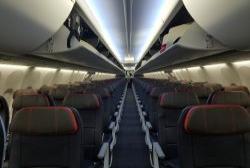
An American Airlines passenger encountered a situation on two consecutive flights where the overhead bins were nearly empty, yet passengers were still required to gate check their carry-on bags. Despite the ample space, passengers weren't allowed to keep their bags with them in the cabin. This scenario is a common complaint among travelers.

(Image Source)
GLOAn American Airlines passenger encountered a situation on two consecutive flights where the overhead bins were nearly empty, yet passengers were still required to gate check their carry-on bags. Despite the ample space, passengers weren’t allowed to keep their bags with them in the cabin. This scenario is a common complaint among travelers, alongside issues like damaged checked luggage.

(Image Source)
The core issue stems from airlines’ policies regarding cabin space. While passengers are permitted to bring carry-on bags, their allowance is contingent upon available space on the aircraft. Thus, boarding early or securing priority boarding can increase the likelihood of finding space for your carry-on.
In contrast, airlines that charge for checked luggage see more passengers attempting to maximize their carry-on space, often leading to overcrowded overhead bins. Even with larger overhead bins being installed, the increased number of carry-on bags means that some passengers are still forced to gate check their luggage.
Historically, passengers could bring two full-sized carry-on bags without such issues, due to lower passenger volumes and the fact that checked luggage was usually free. Today, however, the combination of more passengers and extra charges for checked bags contributes to the frequent problem of overcrowded overhead compartments.
- A quarter-century ago, U.S. airline passengers could typically bring two full-sized carry-on bags without facing issues with overcrowded overhead bins.
- This was due to lower passenger loads and the absence of fees for most checked baggage, which meant passengers didn’t fully utilize the available space.
Carry-on bag restrictions started after 9/11 when federal security measures were implemented. To reduce the volume of items needing screening and expedite checkpoint lines, limits on carry-on bags were introduced.
The trend of more passengers bringing bags into the cabin became significant around 2008, when airlines began charging for the first checked bag. This led to an increase in the number of carry-on bags. Southwest Airlines experiences fewer issues with full overhead bins compared to United, Delta, and American, as they allow up to two 50-pound checked bags free of charge.
Airlines have since expanded overhead bin sizes to improve customer satisfaction and streamline the boarding process, as having to gate check bags can cause delays.
- When passengers discover that overhead bins are full at the last minute, they often have to retrieve their bags after already boarding the plane.
- This can cause delays of five to ten minutes per flight. Repeated delays across multiple flights accumulate, leading to cascading delays and missed connections, which can deter customers from booking those flights due to their inconvenient timing.
- As a result, airlines experience decreased fleet efficiency, meaning they require more aircraft to maintain the same flight schedule.
Unfortunately, larger bins aren’t a complete solution. Even when bins are theoretically sized to fit a full-sized carry-on bag for each passenger,
- This necessitates placing carry-on bags on their side, a practice that many passengers don’t follow. Moreover, efficient use of bin space isn’t consistently achieved.
- Passengers might store multiple items in the bins, their personal items might end up under the seat, or they may bring additional items like jackets in colder weather.
Airlines continue to monitor flights for the need to gate-check bags, even with larger bins. Gate agents may begin requiring gate-checks while there is still ample space available and may not always communicate this decision to the cabin crew.
They often start checking bags before confirming that the bins are completely full, as waiting could mean having passengers already on the jet bridge with their carry-ons. Under significant pressure to ensure flights depart precisely on time, agents may act preemptively to avoid delays.
- A gate agent isn’t typically rewarded for making sure passengers can bring their items onto the plane.
- They might face criticism from supervisors if too many carry-on bags are allowed onboard, as gate-checking bags can delay the flight by a few minutes.
Gate agents are often incentivized to gate-check more bags than necessary, even when larger bins could accommodate everyone’s carry-ons.
This situation explains why passengers now bring more bags onto planes, why airlines have installed larger bins, and yet there is still insufficient space, leading to the continued need for gate-checking bags.
Source: Read Original Content
Disclaimer: Press release
© Press Release 2025
Send us your press releases to news@globalloyalty.org
Press releases originate from external third-party providers. This website does not have responsibility or control over its content, which is presented as is, without any alterations. Neither this website nor its affiliates guarantee the accuracy of the views or opinions expressed in the press release.
The press release is intended solely for informational purposes and does not offer tax, legal, or investment advice, nor does it express any opinion regarding the suitability, value, or profitability of specific securities, portfolios, or investment strategies. Neither this website nor its affiliates are liable for any errors or inaccuracies in the content, nor for any actions taken based on it. By using the information provided in this article, you agree to do so at your own risk.
To the maximum extent permitted by applicable law, this website, its parent company, subsidiaries, affiliates, shareholders, directors, officers, employees, agents, advertisers, content providers, and licensors shall not be liable to you for any direct, indirect, consequential, special, incidental, punitive, or exemplary damages, including but not limited to lost profits, savings, and revenues, whether in negligence, tort, contract, or any other theory of liability, even if the possibility of such damages was known or foreseeable.
The images used in press releases and articles provided by 3rd party sources belong to the respective source provider and are used for illustrative purposes in accordance with the original press releases and publications.
Disclaimer: Content
While we strive to maintain accurate and up-to-date content, Global Loyalty Organisation Ltd. makes no representations or warranties of any kind, express or implied, about the correctness accuracy, completeness, adequacy, or reliability of the information or the results derived from its use, not that the content will meet your requirements or expectations. The content is provided “as is” and “as available”. You agree that your use of the content is at your own risk. Global Loyalty Organisation Ltd. disclaims all warranties related to the content, including implied warranties of merchantability, fitness for a particular purpose, non-infringement, and title, and is not liable for a particular purpose, non-infringement, and title, and is not liable for any interruptions. Some jurisdictions do not allow the exclusion of certain warranties, so these jurisdictions may not apply to you. Global Loyalty Organisation Ltd. Reserves the right to modify, interrupt, or discontinue the content without notice and is not liable for doing so.
Global Loyalty Organisation Ltd. shall not be liable for any damages, including special, indirect, consequential, or incidental damages, or damages for lost profits, revenue, or use, arising out of or related to the content, whether in contract, negligence, tort, statute, equity, law, or otherwise, even if advised of such damages. Some jurisdictions do not allow limitations on liability for incidental or consequential damages, so this limitation may not apply to you. These disclaimers and limitations apply to Global Loyalty Organisation Ltd. and its parent, affiliates, related companies, contractors, sponsors, and their respective directors, officers, members, employees, agents, content providers, licensors, and advisors.
The content and its compilation, created by Global Loyalty Organisation Ltd, are the property of Global Loyalty Organisation Ltd. and cannot be reproduced without prior written permission.
