
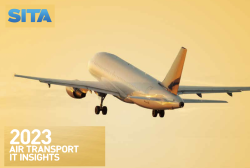
Airports and airlines saw IT spending increase year on year into 2023, reaching an estimated USD10.8 billion and USD34.5 billion, according to SITA’s 2023 Air Transport IT Insights report.

(Image Source)
GLOSITA released its annual “Air Trasnport IT Insights 2023” report.
Key takeaways:
- In an era defined by rapid technological evolution, airlines are positioning themselves for a digital breakthrough.
- They have increased IT spend year on year since 2020, reaching an estimated 34.5 billion USD in 2023, with 99% of airlines predicting an uptick in IT and technology spending in 2023.
- Airports and airlines saw IT spending increase year on year into 2023, reaching an estimated USD10.8 billion and USD34.5 billion.
- Key investment priorities include Business Intelligence (BI) and Artificial Intelligence (AI). With generative AI’s booming popularity and utilization in 2023, a shift is evident – airlines are investing in transformative technologies to navigate operational challenges, optimize the passenger experience, and advance environmental sustainability, making strides towards greener operations. In particular they are exploring alternative revenue channels (with the use of BI in passenger processing for retail doubling year on year). Passenger-centric technology adoption is another key investment area with touchless identity verification, self-service solutions, and real-time monitoring gaining traction.
- Passenger experience: Biometrics are becoming commonplace to help curb congestion, with 70% of airlines expecting to have biometric ID management in place by 2026, and 90% of airports investing in major programs or R&D in this area.
- Sustainability: As sustainability takes center stage, airlines prioritize the renewal of their fleets efficiencies around aircraft turnaround and ground operations, and a commitment to Sustainable Aviation Fuel (SAF). The report reveals a joined industry push towards an environmentally responsible future, with SAF adoption projected to reach 83% by 2026.
- By 2026, over 90% of airlines plan to have IT in place to boost the efficiency of flight operations and aircraft turnaround. More than half have implemented IT to optimise both aircraft taxiing and the takeoff/landing and cruise phases of flights, with nearly all expecting to have this in place by 2026.
- Strategic investments, innovation partnerships, and sustainability initiatives underscore a collective commitment to shaping a resilient, passenger-centric, and environmentally conscious future.
- For airports building and energy management systems are a key priority for offering a unified view of emissions and opportunities to reduce them. Investment in energy management systems* is expected to grow the most of any airport sustainability initiative, with over half of airports planning this by 2026.
- Over two-thirds of airport and airline CIOs expect continued growth into 2024. Key investment priorities include a biometrically enabled passenger journey, leveraging data to unlock operational efficiencies, and green solutions to optimise energy consumption and emissions.

(Image Source)
Source: SITACIOs are now looking to supplement passenger processing advancements with innovative solutions on the operations side. To boost efficiency, protect operations against disruption, and streamline processes for both passengers and staff, CIOs are embracing IT solutions for business intelligence (BI), artificial intelligence, and data sharing.
BI is the most significant area of technology investment for airlines in the coming three years, with 73% investing in significant programmes. Nearly two-thirds of airports and airlines collect and integrate data. With the rise of generative artificial intelligence (AI), they are now looking to AI and machine learning to leverage this data and generate insights. With most citing the “use of data to improve operational efficiency” as at least somewhat of a business challenge, it makes sense that 97% of airlines and 82% of airports are investing in AI by 2026.
(Image Source)
SITA CEO David Lavorel said: “As we approach a full recovery of passenger demand for air travel, with domestic travel even surpassing pre-pandemic levels in some regions, airlines and airports have learned from the congestion and disruptions seen in the past two years. Advanced data sharing and analytics tools will allow them to unite stakeholders and identify opportunities for greater efficiency and leaner operations. Solutions like total airport management and BI for passenger processing provide airports and airlines real-time insight into managing assets and passenger flow, allowing for agile, collaborative responses to disruptions.”… “With industry ambitions to achieve net-zero CO2 emissions by 2050 in mind, airlines and airports are taking necessary steps towards reducing their carbon footprint, adopting digital tools for accurate monitoring and optimisation of energy consumption and emissions,” Lavorel added.

(Image Source)
Source: SITA
The SITA 2023 Air Transport IT Insights research was conducted from August to November 2023. It represents the views of over 250 senior airline and airport executives, covering a quarter of global passenger traffic.
Source: SITA
