

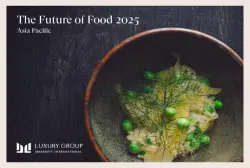
The Luxury Group by Marriott International has released its new comprehensive report, The Future of Food 2025, which highlights the power of the Asia Pacific region in shaping global culinary and dining trends. With insights from more than 30 top chefs, mixologists, and industry insiders from the region, the report identifies 10 macro trends influencing the food and dining industry and the region’s impact on global gastronomy.

(Image Source)
Marriott InternationalThe Luxury Group by Marriott International has released its new comprehensive report, The Future of Food 2025, which highlights the power of the Asia Pacific region in shaping global culinary and dining trends. With insights from more than 30 top chefs, mixologists, and industry insiders from the region, the report identifies 10 macro trends influencing the food and dining industry and the region’s impact on global gastronomy. With the Asia Pacific region at the epicenter of culinary tourism, commanding a 37.8% share of the global market in 2023, with a projected growth of USD 6.2 trillion by 2033, this culinary landscape is powered by both tradition and innovative dining experiences, making it a magnet for food and drink enthusiasts from around the world.
Statements
“The Future of Food 2025 report highlights Asia Pacific’s pivotal role in shaping global culinary landscapes,” said Oriol Montal, managing director of Luxury for Asia Pacific excluding China, Marriott International. “With gastronomy having a significant influence on travel decisions, dining has become an essential component of the global tourism landscape. This report demonstrates our commitment to culinary excellence across all our Luxury Group brands. We will continue to evolve our gastronomy landscape alongside the F&B industry, providing our guests with dining experiences that highlight the region’s rich heritage, flavors, and techniques.”
/safari-india/media/media_files/8fOJnjXUQ6XlfgphrHAW.jpg)
(Image Source)
Petr Raba, vice president of Food & Beverage, Asia Pacific excluding China, Marriott International, added, “We’re not just observing these trends; we are actively contributing to their creation and influence. We’re investing in immersive food experiences, sustainable practices, and innovative technologies to enhance our restaurant and bar offerings in the region. By embracing these emerging trends, we’re not only elevating our guests’ dining experiences but also contributing to the evolution of the global culinary scene.”
/safari-india/media/media_files/6Nr9A0UWsh9TO8xXNWjJ.jpg)
(Image Source)
Key Trends
- From Asia Pacific to the World: From the fusion of Japanese aesthetics into French cuisine, the rising influence of Korean flavours, to the innovative use of traditional spices and techniques from India and Mainland China reshaping Western norms, Asia Pacific is becoming a culinary export powerhouse. The return of diaspora chefs to their native countries infuses local scenes with international flair, showcasing native ingredients and revitalizing traditional recipes. This trend is further bolstered by a growing global appreciation for Asian hospitality and innovation, setting the stage for Asian cuisine to dominate global dining in the future.
- Revival of forgotten ingredients and traditions: Amid rising environmental concerns, chefs have a deeper appreciation for labor-intensive traditions and forgotten ingredients, integral to Asia Pacific heritage. Across the region, chefs are not only preserving but innovating within their culinary traditions, from nose-to-tail cooking to artisanal jang production, making significant contributions to both their cultural heritage and global sustainability efforts.
/safari-india/media/media_files/fZaziWKJ5wcBp0HbhmX7.jpg)
(Image Source)
- Fine dining redefined: Dining outlets are celebrating lesser-known regional cuisines, offering culturally enriching and gastronomically satisfying dining adventures. Fine dining establishments are pivoting towards exclusivity by elevating prices, limiting covers, and introducing membership-based access, creating unparalleled value for guests through exceptional experiences. Additionally, the emphasis on quality over quantity and shorter, faster, more relaxed dining experience in intimate settings is becoming prominent.
- Wellness on the plate: The wellness revolution is influencing food choices. While anti-aging foods that support hormone balance and enhance dopamine levels gain popularity, longevity is the new luxury. Food is regarded as medicine, with restaurants shifting to offering nutritious, chef-curated menus that prioritize fresh, whole ingredients and transparent sourcing. Hyper-personalized diets powered by AI can provide meal recommendations based on individual physiological and psychological states.
/safari-india/media/media_files/rW3E8xvZfxHsKZuB2AK1.jpg)
(Image Source)
- Emerging Culinary Destinations: As infrastructure and digital connectivity improve, new hotspots for culinary tourism are emerging, solidifying the region’s status as a global center for cultural and culinary excellence. The report identifies the diverse and vibrant food cultures in Bali, Busan, Ho Chi Minh City, Jeju, Kuala Lumpur, Manila, Mumbai, Niseko, Shanghai, and Tasmania. They are redefining local dining scenes and setting new standards in global gastronomy with unique, hyperlocal dining experiences that celebrate indigenous ingredients and traditional cooking techniques.
- Conscious Cuisine: Sustainability efforts include regenerative farming, addressing the water crisis, and digitizing the supply chain are seen to enhance food security and waste reduction.
- Farm-to-Future: The integration of sustainable practices from biodynamic farming, plant-centric dining to upcycled ingredients are driving incremental improvements, ensuring that our future generations can continue to enjoy diverse cuisines.
- Pour it Forward: Innovations in beverages, including craft cocktails and non-alcoholic options alongside the experience-driven spaces, are redefining bar experiences.
- High-Tech, High-Touch: Technology enhances the dining experience without diminishing the personal touch that is central to hospitality.
- Sensory Dining and Sustainable Spaces: Restaurants are becoming arenas for multisensory experiences integrated with technology that are both enjoyable and environmentally conscious.
Source: Marriott
Disclaimer: Press release
© Press Release 2025
Send us your press releases to news@globalloyalty.org
Press releases originate from external third-party providers. This website does not have responsibility or control over its content, which is presented as is, without any alterations. Neither this website nor its affiliates guarantee the accuracy of the views or opinions expressed in the press release.
The press release is intended solely for informational purposes and does not offer tax, legal, or investment advice, nor does it express any opinion regarding the suitability, value, or profitability of specific securities, portfolios, or investment strategies. Neither this website nor its affiliates are liable for any errors or inaccuracies in the content, nor for any actions taken based on it. By using the information provided in this article, you agree to do so at your own risk.
To the maximum extent permitted by applicable law, this website, its parent company, subsidiaries, affiliates, shareholders, directors, officers, employees, agents, advertisers, content providers, and licensors shall not be liable to you for any direct, indirect, consequential, special, incidental, punitive, or exemplary damages, including but not limited to lost profits, savings, and revenues, whether in negligence, tort, contract, or any other theory of liability, even if the possibility of such damages was known or foreseeable.
The images used in press releases and articles provided by 3rd party sources belong to the respective source provider and are used for illustrative purposes in accordance with the original press releases and publications.
Disclaimer: Content
While we strive to maintain accurate and up-to-date content, Global Loyalty Organisation Ltd. makes no representations or warranties of any kind, express or implied, about the correctness accuracy, completeness, adequacy, or reliability of the information or the results derived from its use, not that the content will meet your requirements or expectations. The content is provided “as is” and “as available”. You agree that your use of the content is at your own risk. Global Loyalty Organisation Ltd. disclaims all warranties related to the content, including implied warranties of merchantability, fitness for a particular purpose, non-infringement, and title, and is not liable for a particular purpose, non-infringement, and title, and is not liable for any interruptions. Some jurisdictions do not allow the exclusion of certain warranties, so these jurisdictions may not apply to you. Global Loyalty Organisation Ltd. Reserves the right to modify, interrupt, or discontinue the content without notice and is not liable for doing so.
Global Loyalty Organisation Ltd. shall not be liable for any damages, including special, indirect, consequential, or incidental damages, or damages for lost profits, revenue, or use, arising out of or related to the content, whether in contract, negligence, tort, statute, equity, law, or otherwise, even if advised of such damages. Some jurisdictions do not allow limitations on liability for incidental or consequential damages, so this limitation may not apply to you. These disclaimers and limitations apply to Global Loyalty Organisation Ltd. and its parent, affiliates, related companies, contractors, sponsors, and their respective directors, officers, members, employees, agents, content providers, licensors, and advisors.
The content and its compilation, created by Global Loyalty Organisation Ltd, are the property of Global Loyalty Organisation Ltd. and cannot be reproduced without prior written permission.
