
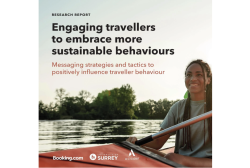
What motivates travellers to adopt sustainable behaviours? A new report co-produced by Accor, Booking.com and the University of Surrey delves into this question through an in-depth study. It includes 24 traveller interviews, the journey analysis of 22 additional travellers and rigorous lab-based behavioural research with 67 participants.

(Image Source)
AccorEngaging Travellers in Sustainable Practices: Insights from Accor, Booking.com, and the University of Surrey
Sustainable travel is no longer a niche concern but a mainstream priority for today’s travellers. A recent study conducted by Accor, Booking.com, and the University of Surrey has provided groundbreaking insights into how hospitality providers can effectively communicate their sustainability efforts to guests. By leveraging cutting-edge technologies, including eye tracking, galvanic skin response analysis, and facial recognition software, the study uncovered key strategies for encouraging more responsible travel behaviours.
Source: Accor
A Collaborative Effort for Change
As part of this initiative, Jordane de Villaret, VP of Sustainability Marketing & Communication at Accor, emphasized the project’s purpose:
“Our partnership with Booking.com and the University of Surrey aims to equip marketing and communication experts with actionable insights that truly engage guests in our hotels’ impact journey. By sharing this work openly, we hope to inspire both global brands and independent properties to craft compelling narratives that empower guests to be part of the change.”
With 83% of travellers viewing sustainable travel as important and 67% reporting they feel more inclined to adopt responsible practices when they see them in action, the hospitality sector has a unique opportunity to drive positive behavioural shifts. However, one of the primary challenges remains: how to communicate sustainability efforts in a way that is engaging, persuasive, and impactful.
The research findings are compiled in the report titled Engaging Travellers to Embrace More Sustainable Behaviours, which serves as a valuable resource for hospitality professionals. The report outlines four key strategies to effectively communicate sustainability efforts and influence guest behaviour.
Key Strategies for Effective Sustainability Communication
1. Highlight Sustainability Practices Clearly and Encourage Guest Participation
One of the biggest barriers to guest engagement in sustainability efforts is vague or overly broad messaging. The research shows that:
-
Clear, specific communication around sustainable practices prevents scepticism.
-
Showcasing tangible, credible actions—such as energy conservation or waste reduction—enhances trust.
-
Evidence-based data from trusted sources, paired with actionable steps, empowers guests to make informed decisions.
-
Providing credible third-party certifications reassures travellers of the legitimacy of sustainability claims.
By making sustainability efforts more transparent and demonstrating how guests can contribute, hotels can inspire greater participation and positive impact.
2. Balance Appeal to Pleasure and Comfort
Sustainability is sometimes perceived as restrictive or less enjoyable, which can deter guests from embracing eco-friendly practices. The research found that framing sustainability in a way that highlights comfort and pleasure significantly enhances guest satisfaction:
-
Messaging emphasizing comfort led to a 145% increase in guest satisfaction.
-
Messaging focused on pleasure resulted in a 475% increase in positive emotions, but also led to increased scepticism if overused.
-
Promoting sustainable experiences such as scenic train rides or locally sourced culinary experiences reassures guests they can enjoy their stay without sacrificing enjoyment.
-
Comfort messaging reassures guests and makes them more receptive to sustainability efforts.
By aligning sustainability messaging with comfort and positive experiences, hotels can make responsible choices more appealing.
3. Empower Guests, Don’t Dictate
Guests respond better to informative and empowering messages rather than direct orders. The study highlights that:
-
55% of guests were sceptical of directives like “limit your water use.”
-
70% of guests felt a hotel was more responsible when given empowering sustainability messages.
-
Messages that tell guests what they “must” do can backfire, making them feel restricted rather than engaged.
-
Instead of imposing restrictions, hospitality providers should offer guidance and resources that help guests make informed decisions—such as sharing local transit options or eco-friendly dining recommendations.
This fosters a sense of autonomy and encourages guests to align their choices with their values.
4. Encourage Guests to Maintain Sustainable Habits While Travelling
Many travellers seek to maintain their sustainable habits while on the road. The research reveals that:
-
Messaging that evokes feelings of “home” enhances trust and familiarity.
-
This approach halved scepticism and doubled perceptions of a hotel’s responsibility.
-
Guests prefer to continue their sustainable habits while traveling, but often face barriers due to hotel policies.
-
Helping guests feel “at home” in their sustainable choices makes responsible actions feel natural.
By fostering a welcoming, home-like environment and providing resources that support responsible behaviour, hotels can create a more sustainable and engaging guest experience.
Key Takeaways from the Report
-
Small nudges in guest behaviour can lead to big sustainability impacts – simple actions like real-time shower duration feedback reduced water usage by 9.5 litres per shower.
-
Sustainability messaging must be specific and action-oriented – vague terms lead to scepticism, while clear communication enhances trust.
-
Encouraging guests rather than directing them enhances effectiveness – authoritative messaging discourages engagement, while empowering messages foster cooperation.
-
Sustainability should enhance, not hinder, guest experience – balancing pleasure and comfort in messaging makes responsible travel feel effortless.
-
Guests want to continue their sustainable habits while travelling – hotels should facilitate this by making responsible actions seamless and familiar.
A Shared Commitment to a Sustainable Future
The findings from this study represent a significant step forward in understanding how to engage travellers in sustainable practices. By implementing these strategies, hospitality providers can not only contribute to environmental conservation but also enhance guest satisfaction and brand loyalty.
With a shared commitment to sustainability, Accor, Booking.com, and the University of Surrey have provided a valuable resource that aims to inspire the entire hospitality industry. As more hotels and travel brands embrace these insights, they can help shape a future where sustainable travel is not just an option but a standard expectation.
Source: Accor
Disclaimer: Press release
© Press Release 2025
Send us your press releases to news@globalloyalty.org
Press releases originate from external third-party providers. This website does not have responsibility or control over its content, which is presented as is, without any alterations. Neither this website nor its affiliates guarantee the accuracy of the views or opinions expressed in the press release.
The press release is intended solely for informational purposes and does not offer tax, legal, or investment advice, nor does it express any opinion regarding the suitability, value, or profitability of specific securities, portfolios, or investment strategies. Neither this website nor its affiliates are liable for any errors or inaccuracies in the content, nor for any actions taken based on it. By using the information provided in this article, you agree to do so at your own risk.
To the maximum extent permitted by applicable law, this website, its parent company, subsidiaries, affiliates, shareholders, directors, officers, employees, agents, advertisers, content providers, and licensors shall not be liable to you for any direct, indirect, consequential, special, incidental, punitive, or exemplary damages, including but not limited to lost profits, savings, and revenues, whether in negligence, tort, contract, or any other theory of liability, even if the possibility of such damages was known or foreseeable.
The images used in press releases and articles provided by 3rd party sources belong to the respective source provider and are used for illustrative purposes in accordance with the original press releases and publications.
Disclaimer: Content
While we strive to maintain accurate and up-to-date content, Global Loyalty Organisation Ltd. makes no representations or warranties of any kind, express or implied, about the correctness accuracy, completeness, adequacy, or reliability of the information or the results derived from its use, not that the content will meet your requirements or expectations. The content is provided “as is” and “as available”. You agree that your use of the content is at your own risk. Global Loyalty Organisation Ltd. disclaims all warranties related to the content, including implied warranties of merchantability, fitness for a particular purpose, non-infringement, and title, and is not liable for a particular purpose, non-infringement, and title, and is not liable for any interruptions. Some jurisdictions do not allow the exclusion of certain warranties, so these jurisdictions may not apply to you. Global Loyalty Organisation Ltd. Reserves the right to modify, interrupt, or discontinue the content without notice and is not liable for doing so.
Global Loyalty Organisation Ltd. shall not be liable for any damages, including special, indirect, consequential, or incidental damages, or damages for lost profits, revenue, or use, arising out of or related to the content, whether in contract, negligence, tort, statute, equity, law, or otherwise, even if advised of such damages. Some jurisdictions do not allow limitations on liability for incidental or consequential damages, so this limitation may not apply to you. These disclaimers and limitations apply to Global Loyalty Organisation Ltd. and its parent, affiliates, related companies, contractors, sponsors, and their respective directors, officers, members, employees, agents, content providers, licensors, and advisors.
The content and its compilation, created by Global Loyalty Organisation Ltd, are the property of Global Loyalty Organisation Ltd. and cannot be reproduced without prior written permission.

